Tax & Estate Planning
Your Pension is about to Become Part of your Estate


AT A GLANCE
Who should read this
• Anyone whose home, savings, investments and pensions together come close to, or above, £500,000 (or £1 million for a married couple or civil partners with children).
• Anyone who has been leaving their pension untouched to pass on to family.
• Anyone aged 75 or over, or approaching it, with money still in a pension.
• Anyone named as an executor of a parent’s or relative’s will.
What you can do
• Add up your estate including your pensions, and compare it with your allowances.
• Review the order you draw on your savings, and whether to take your tax-free cash.
• Consider gifting, particularly regular gifts from surplus income.
• Check your pension nominations, and tell your executors which pensions you hold.
Take advice before April 2027, but don’t rush into stopping contributions.
For years, the established wisdom in retirement was simple for estates with an Inheritance tax issue: spend your other savings first and leave your pension alone. It sat outside your estate for inheritance tax, so it was often the most tax-efficient thing you could pass on.
There are lots of people that followed this approach carefully. They drew on their ISAs and cash, kept their pension invested, and quietly earmarked it for their children and grandchildren as a legacy.
From 6 April 2027, that plan stops working the way it was designed to.
What's changing
Under the Finance Act 2026, which became law in March, most unused pension money will count as part of your estate for inheritance tax if you die on or after 6 April 2027. That includes personal pensions, SIPPs, workplace pension pots, and any drawdown funds you haven't spent.
Not everything goes into your estate. Anything left to a spouse, civil partner or registered charity remains free of inheritance tax. Active death-in-service lump sums from an employer's scheme are excluded, as are most pensions paid by a scheme directly to a dependant.
The number that matters: £33
If you die before 75, the people who inherit your pension can draw it free of income tax, as per the current rules. If you die at 75 or over, they already pay income tax at their own rate on what they take out. From April 2027, inheritance tax gets deducted first and then income tax on the withdrawal.
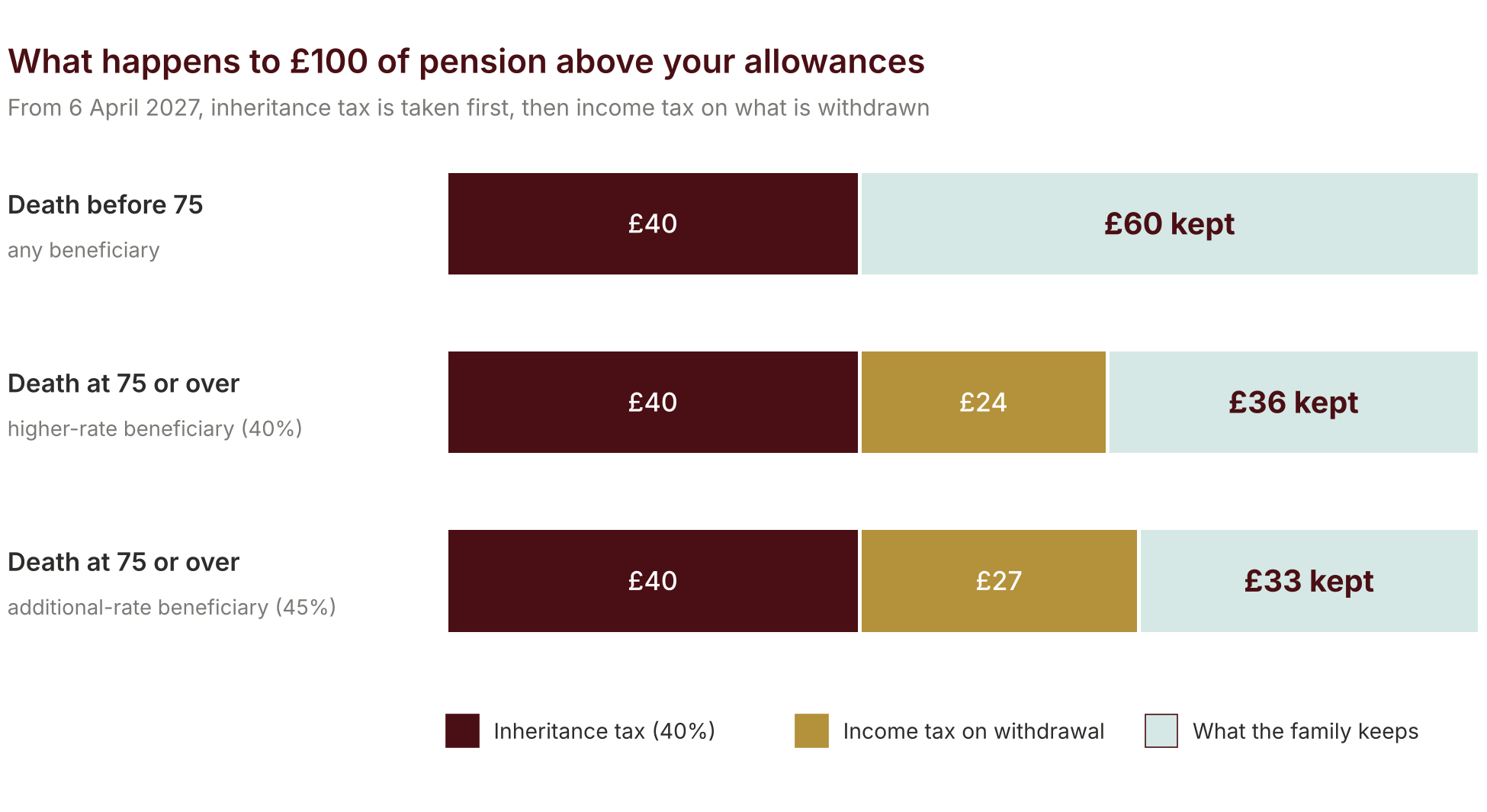
That is the worst case, not the typical one, but it shows what is at stake. The government's own estimate is that in 2027–28 around 10,500 estates will pay inheritance tax that wouldn't have done before, and around 38,500 will pay more, with their bill rising by about £34,000 on average.
Does this affect me?
Start with your allowances. Everyone has a tax-free allowance of £325,000. Leaving your home to children or grandchildren can add up to £175,000 more. Married couples and civil partners can pass unused allowances to each other, so a couple with children may be able to leave up to £1 million free of inheritance tax.
Now add up your home, savings, investments, and pensions. If the total sits comfortably below your allowances, the change may make little difference to you. If it doesn't, you need to take a closer look.
Three things are easy to miss.
The bill often arrives on the second death. Because pensions left to a spouse are exempt, many couples will not see a problem when the first of them dies. It appears later when everything passes to the next generation.
A large pension can cost you an allowance. The extra £175,000 home allowance is gradually withdrawn once an estate is worth more than £2 million, and pensions now count towards that figure.
Your executors will carry more of the load. They become responsible for reporting and paying inheritance tax on your pensions, even though they don't control that money. Schemes can be asked to hold back up to half of a beneficiary's payment for up to 15 months while the tax is worked out. For a grieving family, it means more forms and more deadlines. Making sure your executors know which pensions you have, and where, is a simple kindness.
What can I do?
First, the reassuring part. Pensions haven't become a bad idea. Contributions still attract tax relief, investments still grow free of income tax and capital gains tax, and a pension's main job, paying for your retirement, hasn't changed. Stopping contributionsin a hurry could easily cost more than it saves.
What has changed is that a pension is no longer the obvious thing to leave untouched. Depending on your circumstances, it may be worth looking at:
• The order you draw on your money. Taking more from your pension and leaving other savings for longer may now suit some people. But anything above the tax-free portion is taxed as income, so this needs planning year by year.
• Your tax-free cash. You can usually take up to a quarter of your pension tax free. However, once it has been withdrawn, it sits in your estate unless you spend it or give it away.
• Giving during your lifetime. Regular gifts from surplus income that don't affect your standard of living can be free of inheritance tax straight away. Larger gifts usually fall outside your estate after seven years.
• Who you've nominated. Your pension scheme usually decides who receives your pension, guided by your nomination. Check it's up to date and in line with your wishes.
• Charitable giving. Leaving at least 10% of your net estate to charity reduces the Inheritance tax rate on the rest from 40% to 36%.
• Life cover written in trust. For some families, a policy designed to pay the expected bill is simpler than restructuring everything else.
A conversation worth having
It is imperative to not rush into a decision, and for many people the right answer may be to change very little. But the rules are shifting dramatically, and plans built around the current rules need a fresh look before April 2027.
If you'd like to talk through what this means for you and your family, we'd be happy to have that conversation.
This article is for information only and does not constitute personal financial or tax advice. It reflects our understanding of legislation and HMRC practice at the time of writing, which may change. Tax treatment depends on your individual circumstances. The Financial Conduct Authority does not regulate will writing, trusts or some forms of tax and estate planning.